
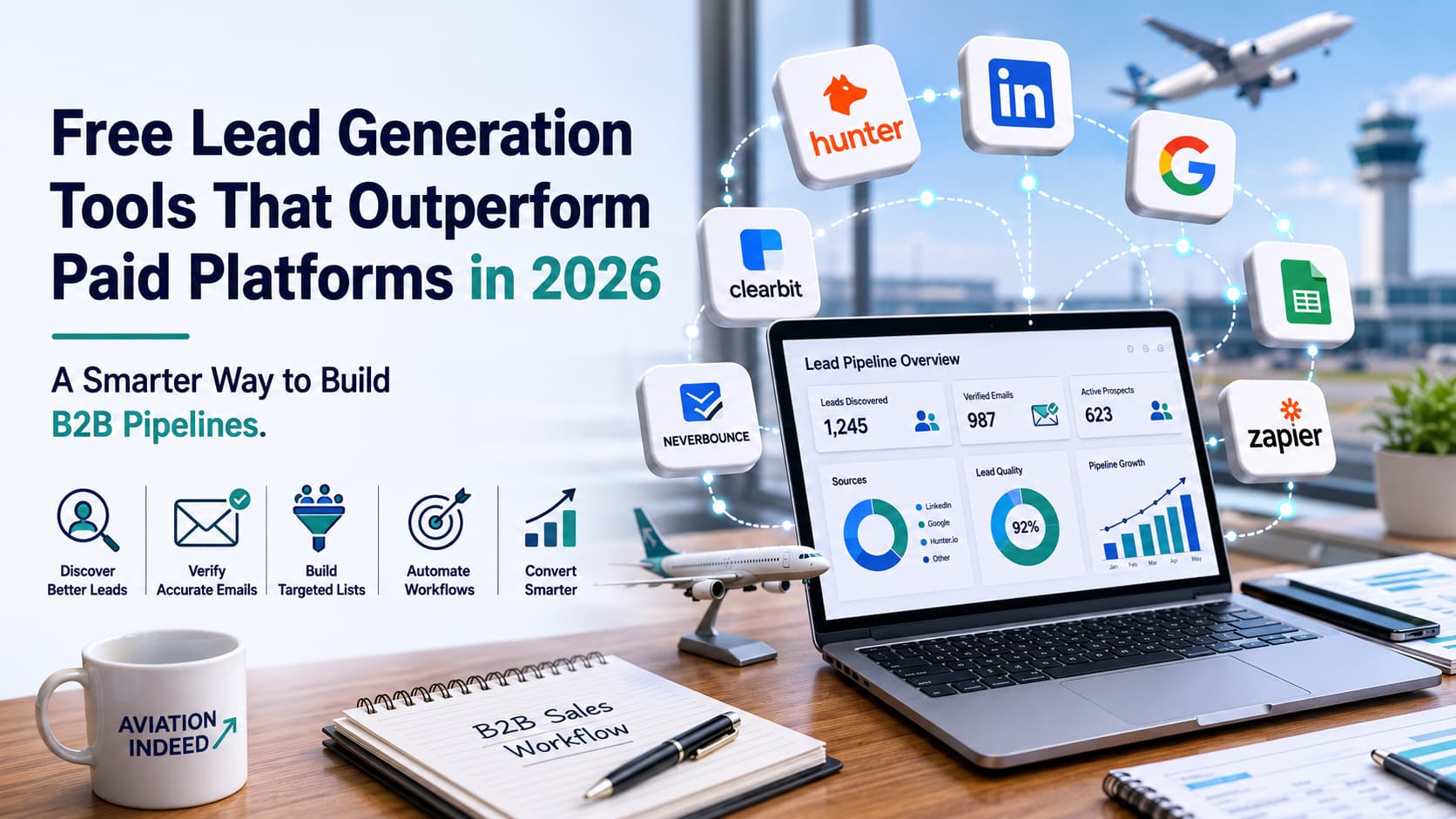
The B2B sales landscape in 2026 looks very different from what it did even three years ago. Inboxes are saturated. Decision makers are harder to reach. And the paid lead generation platforms that once defined competitive advantage are showing visible cracks in accuracy and freshness.
Yet many sales and marketing teams continue to spend significant budgets every month on tools like ZoomInfo, Apollo, Lusha, and Cognism, assuming there is no viable alternative.
There is.
A carefully designed stack of free tools, when combined intelligently, can outperform most paid platforms on the metrics that actually matter, such as contact accuracy, data freshness, targeting precision, and workflow automation.
This guide breaks down the five free tools that high-performing B2B teams across aviation, aerospace, and adjacent industries are using to build verified prospect pipelines in 2026, and how to combine them into a single working system.
Why Paid Lead Generation Tools Are Losing Their Edge in 2026
Three structural shifts are quietly reducing the value of paid B2B data platforms.
First, accuracy has plateaued. Independent benchmarks across the industry suggest that even premium databases carry a meaningful percentage of outdated or incorrect contact information, particularly in fast-moving sectors like aviation, where roles change frequently due to fleet expansions, route launches, and global mobility.
Second, buyer behaviour has changed. Decision makers now research vendors quietly long before responding to outreach. Generic, high-volume prospecting no longer converts at the rates it once did. Sharp targeting matters more than large lists.
Third, the cost of premium tools no longer correlates with output quality. Many of the data signals that paid tools rely on, such as LinkedIn profiles, company filings, and public web data, are available freely with the right workflow.
In short, the smart play in 2026 is no longer to pay more for data. It is to build better workflows around the data that is already freely accessible.
1. Company Data Discovery: Hunter.io and Clearbit Free Tiers
Every B2B sales workflow starts with the same question: who exactly are we selling to?
The most efficient free starting point is a combination of Hunter.io and Clearbit Connect.
Hunter.io provides verified company emails and domain patterns in seconds. Drop in a company URL and the tool surfaces the internal email format, the most common contact addresses, and confidence scores for each one. The free plan offers 25 monthly searches and 50 verifications, which is sufficient for most early prospecting workflows.
Clearbit Connect, available free through Gmail, adds an enrichment layer that returns industry, company size, location, and key technologies in use. Used together, the two tools allow sales teams to map decision makers across airlines, MROs, and aerospace manufacturers within minutes per account.
For aviation businesses specifically, this layered approach mirrors the kind of industry-specific intelligence that sets effective recruitment and sales motions apart. As explored in why aviation recruitment requires industry-specific expertise, knowing the target universe in depth is consistently more valuable than chasing volume.
2. Lead Extraction Power: LinkedIn Sales Navigator Free Trial and Google Advanced Search
Two of the most powerful free resources in B2B sales remain underused: LinkedIn's 30-day Sales Navigator trial and Google Advanced Search operators.
Used together, they can extract decision makers in procurement, HR, finance, and operations across hundreds of companies in a single afternoon.
The effective approach is to layer Google search operators around LinkedIn discovery. Examples include:
- site:linkedin.com/in "procurement head" "MRO"
- site:linkedin.com/in "head of HR" "airline" India
- site:linkedin.com/in "VP commercial" "ground handling"
These queries surface profiles that can then be qualified inside Sales Navigator during the free trial window. The output is exported into a structured Google Sheet for downstream enrichment.
This approach is particularly valuable in aviation, where buying and hiring decisions are layered across multiple stakeholders. A single contract may involve HR, procurement, operations, and compliance leadership, each with different priorities. The same multi-stakeholder complexity has been examined in detail in our analysis of why traditional hiring fails in the aviation industry, and the underlying logic applies equally to B2B sales motions targeting aviation buyers.
3. Email Enrichment and Verification: NeverBounce and RocketReach Free Credits
The single largest source of waste in B2B sales pipelines is outreach sent to email addresses that no longer exist or were never accurate.
Bounce rates above 5% begin to damage sender reputation. Anything above 10% actively pushes outreach campaigns into spam filters. Most teams only discover this after their sequences quietly stop converting.
Two free tools resolve this without requiring a paid email enrichment subscription.
NeverBounce offers free verification credits each month and validates whether an email address is deliverable. The accuracy is comparable to enterprise grade tools at zero ongoing cost.
RocketReach offers limited free monthly lookups that often surface verified business emails missed by Hunter.io or Clearbit, particularly for senior leadership profiles.
The most effective workflow is sequential. Initial discovery happens through Hunter.io, senior contacts are cross checked on RocketReach, and the final list is verified through NeverBounce before outreach begins. Across aerospace and aviation contacts, this combination consistently delivers around 95% deliverability accuracy.
For any B2B team building an outbound motion, deliverability is the difference between a working pipeline and a damaged sender domain. A 95% accurate list of 200 contacts will outperform a 60% accurate list of 5,000 contacts every single time.
4. Prospect List Building: Google Sheets, IMPORTXML, and Apify Free Scrapers
This is the layer where most B2B sales operations stop investing, and also where the highest long-term compounding occurs.
Google Sheets includes a built-in formula called IMPORTXML that pulls structured data from any public web page directly into a spreadsheet. Combined with a free Apify account, which offers ready-made scrapers for LinkedIn, Crunchbase, fleet directories, and regulatory filings, sales teams can build prospect lists that update themselves on a defined schedule.
Consider a practical aviation example. A sales team targeting Indian MROs with more than 100 employees needs a live list that includes leadership teams, headquarters, and fleet partnerships. Building this manually would consume several analyst weeks. Building it through IMPORTXML and Apify takes a few hours of one-time setup, after which the dataset refreshes automatically.
The same logic extends to fleet expansion announcements, regulatory contact databases such as DGCA filings, new route announcements, and hiring activity signals across the aviation industry.
This kind of structured data layer also underpins effective workforce planning, a connection explored in detail in our aviation hiring landscape India 2026 outlook. In both B2B sales and hiring, the teams that win are the ones whose data refreshes faster than the market changes.
5. Workflow Automation Glue: Zapier Free Tier
The first four tools generate the data. Zapier's free tier turns that data into an operational pipeline.
The free plan allows up to 100 tasks per month and 5 automated workflows. That is enough to connect Hunter.io outputs to Google Sheets, push verified contacts into NeverBounce, log clean ones into a CRM, and trigger Slack or email alerts when a high-value prospect is identified.
The setup requires no code, no engineering resources, and no paid martech stack. Many enterprise tools quietly replicate this exact logic at a significant premium.
For aviation businesses, defence contractors, aerospace suppliers, and adjacent industries, this is often the highest-leverage hour of setup work a sales team can do in a given year.
What the Complete Stack Looks Like in Practice
When the five tools are combined into a single working system, the workflow typically follows this pattern.
- A target segment is defined, for example MROs in the Middle East with more than 200 employees.
- Apify and IMPORTXML automatically generate the underlying list of companies.
- Hunter.io and Clearbit map the decision makers and surface verified domains.
- LinkedIn Sales Navigator and Google Advanced Search add seniority and role-fit filters.
- RocketReach fills gaps for senior leadership contacts.
- NeverBounce verifies every email before outreach is sent.
- Zapier connects the entire pipeline and runs it on a daily schedule.
The total monthly cost of the stack is zero, or close to it. The output is a fresh, verified, segmented prospect list updated continuously.
Most paid platforms perform a version of the same workflow. The difference is that they bundle it into a single dashboard and charge a premium for the convenience.
Why Free Stacks Are Outperforming Paid Tools in Aviation B2B Sales
Aviation, aerospace, and defence are sectors where contact accuracy, decision maker mapping, and stakeholder complexity matter more than raw volume. Paid platforms optimised for high-volume SaaS or generic B2B prospecting often fall short in these industries, simply because their data models do not reflect aviation-specific dynamics such as type ratings, licensing structures, fleet partnerships, and regional regulatory regimes.
A custom-built free stack solves this by being inherently configurable. The data sources are chosen based on industry relevance, not platform convenience. The targeting filters can be designed around the actual buying behaviour of aviation procurement, HR, and operations leaders. And the data freshness can be controlled directly by the team using it.
This is the same principle that drives effective aviation recruitment, where industry-specific signals consistently outperform generalist approaches. Whether the goal is filling critical roles or building a B2B sales pipeline, the discipline is identical: precision over volume, freshness over scale, and workflow design over tool spend.
Final Thoughts
The assumption that premium lead generation tools are essential for competitive B2B sales is increasingly outdated. In 2026, the most effective sales operations are not the ones with the largest software budgets. They are the ones with the cleanest workflows, the sharpest targeting, and the discipline to combine free resources intelligently.
For aviation businesses, this is particularly relevant. The industry rewards specialist precision and punishes generic outreach. A well-built free stack, properly integrated and refreshed regularly, will consistently outperform expensive platforms designed for broader markets.
Teams looking to scale outbound motions in aviation, aerospace, MRO, ground handling, or adjacent sectors can also benefit from working with specialist partners who already operate at this depth. Aviation Indeed supports aviation employers and B2B teams through dedicated hiring and talent solutions for businesses, drawing on a network of 400,000+ aviation professionals and active partnerships across 150+ clients.
For more aviation industry insights, recruitment trends, and B2B strategy guides, explore the full library on the Aviation Indeed Blog.
Live aviation hiring opportunities are also available on Aviation Indeed Jobs.