
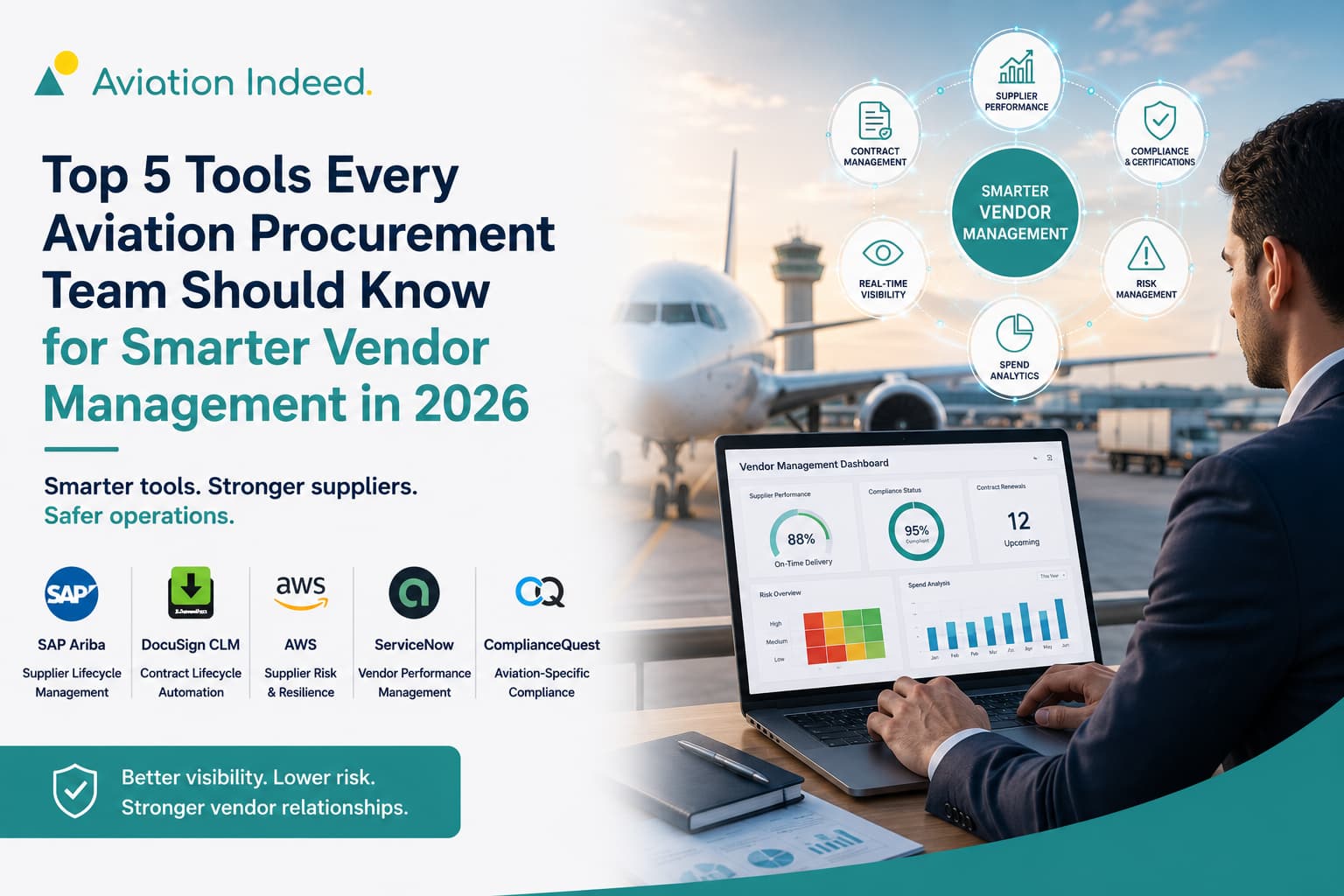
Ask any aviation procurement leader two simple questions. How many supplier contracts are up for renewal this month? And how confident are they that nothing is slipping through?
In most aviation organisations, those questions are surprisingly difficult to answer with precision.
Supplier data sits across spreadsheets. Performance reviews are tracked manually. Renewals are buried in shared drives. Compliance certifications expire quietly, and the procurement team finds out only when a regulatory audit or an operational incident forces the issue.
This is not a reflection of weak procurement teams. It is a reflection of how operationally demanding aviation procurement has become. Suppliers must meet Part 145 approvals, GCAA and EASA standards, AS/EN9120 accreditation, and a long list of safety and traceability requirements. Contracts span power-by-the-hour (PBH), fixed-price, blended commercial models, lease structures, and project-based engagements. A single missed renewal on a Part 145 approval can stop an aircraft from returning to service.
The aviation procurement teams getting this right in 2026 are not the ones working harder. They are the ones using the right combination of tools to bring structure, automation, and visibility into vendor management.
This guide breaks down the five vendor management tools that aviation procurement leaders across airlines, MROs, and ground handling firms are increasingly relying on, including one platform built specifically for the compliance demands of aviation suppliers that most procurement teams outside the industry have not yet come across.
Why Aviation Vendor Management Is Different from Standard Procurement
Before examining the tools themselves, it is worth being clear about why aviation procurement cannot be managed using the same playbook as standard B2B procurement.
Three structural differences set it apart.
First, regulatory layering. Suppliers must demonstrate compliance with multiple frameworks at once. A single MRO vendor may be expected to maintain EASA Part 145 approval, FAA repair station certification, GCAA approval for Middle East operations, AS/EN9120 accreditation, and increasingly, EASA Part-IS cybersecurity compliance introduced through Regulation (EU) 2023/203.
Second, contract complexity. Aviation contracts rarely follow a simple purchase order model. Power-by-the-hour arrangements, fleet-wide pooling agreements, lease structures with embedded maintenance reserves, and long-tail spares contracts all coexist within the same supplier base. Many of these contracts include renewal clauses, performance triggers, and obligations that span years.
Third, operational consequence. In most industries, a supplier issue creates a cost problem. In aviation, a supplier issue can create a grounded aircraft, a delayed inbound rotation, or a regulatory finding. The cost of vendor management failure is significantly higher than in other sectors.
These three differences shape what an effective vendor management toolset looks like for aviation. The goal is not just to track suppliers. It is to maintain real-time, audit-ready visibility into supplier performance, compliance status, contract obligations, and risk exposure, across a base that is often distributed globally.
Many of the deeper hiring and operational challenges that drive procurement complexity in aviation are explored in our analysis of why traditional hiring fails in the aviation industry, where similar themes of compliance, specialisation, and operational risk apply equally to vendor selection.
1. SAP Ariba: Supplier Performance and Lifecycle Management at Scale
SAP Ariba remains one of the most widely deployed procurement platforms among large airlines, MROs, and aerospace organisations, particularly through its Supplier Lifecycle and Performance (SLP) module.
The platform centralises supplier registration, qualification, segmentation, and performance evaluation in a single dashboard. For aviation procurement teams, the most relevant capabilities include modular questionnaires for collecting certification and compliance data, ESG and sustainability tracking, predictive risk analysis powered by machine learning, and closed-loop corrective action workflows for underperforming suppliers.
The Ariba Network connects to over five million suppliers globally, which is particularly useful when aviation procurement teams need to identify alternative sources for spares, MRO services, or specialist consumables during supply chain disruptions.
SAP Ariba is most suitable for large enterprises with mature procurement functions, significant supplier bases, and integration requirements with SAP ERP or S/4HANA. Implementation is not lightweight. It requires dedicated resources, structured governance, and several months of deployment. For organisations operating at fleet scale, however, the long-term operational benefit is substantial.
Where SAP Ariba creates the most value in aviation is in standardising supplier evaluation across geographies. A global airline managing MRO partners across Europe, the Middle East, and Asia can apply consistent KPI frameworks, certification checks, and performance scorecards through one system, rather than relying on regional spreadsheets that quickly drift out of sync.
2. DocuSign CLM: Contract Lifecycle Automation for Aviation Procurement
Contract management is one of the most underappreciated risk areas in aviation procurement. With multi-year PBH agreements, fleet leases, Part 145 service contracts, and regional ground handling deals all running simultaneously, a single missed renewal or unenforced clause can trigger significant operational and financial exposure.
DocuSign CLM, recognised as a Leader in the 2025 IDC MarketScape for AI-Enabled Buy-Side Contract Lifecycle Management Applications, has become a standard reference point for procurement teams looking to bring discipline to this area.
The platform consolidates the entire contract lifecycle into a single system: drafting from pre-approved templates, multi-step approval routing, AI-driven clause analysis, electronic signature execution, central repository storage, and post-signature obligation tracking. Reported industry benchmarks include 90% less time spent on contract generation and an 85% reduction in contract-related errors.
For aviation procurement specifically, the most operationally useful features include automated alerts for expiring approvals (Part 145, AS/EN9120, AOC-linked supplier authorisations), AI-driven extraction of key contract obligations across PBH and lease agreements, native integration with SAP Ariba for source-to-pay workflows, and integration with Salesforce, Microsoft, and Google environments for cross-functional collaboration with legal, finance, and operations teams.
One important note. DocuSign CLM is an enterprise-grade platform, and implementation typically takes months rather than weeks. For organisations already on DocuSign eSignature, the upgrade path is more efficient because the eSignature integration is native, removing the friction that exists when other CLM vendors are bolted onto third-party signature solutions.
3. Coupa: Supplier Risk and Spend Management with a Global Network
Coupa is increasingly used by aviation procurement teams that prioritise rapid deployment, strong user experience, and access to community-driven supplier insights.
The platform's Supplier Risk and Performance module is built around four areas: a supplier self-service portal that reduces manual onboarding effort, comprehensive risk monitoring across financial, geographic, regulatory, and operational dimensions, multi-domain risk assessments that surface issues before they affect operations, and tools for diversifying the supplier base across categories.
What makes Coupa distinctive for aviation procurement is its Business Spend Management network, which now draws on more than eight trillion dollars of community spend data. The platform's AI agents, marketed as Coupa Navi, use this dataset to predict supply chain disruptions and prescribe sourcing optimisations. For procurement teams operating in volatile supply environments, particularly during fleet expansions or sudden capacity ramps, this kind of community-driven intelligence can shorten decision cycles meaningfully.
Coupa is generally better suited to organisations that prioritise speed of adoption and indirect spend management. For aviation procurement teams managing significant indirect spend categories such as ground services, IT, facilities, training, and professional services, Coupa often provides faster time to value than larger ERP-anchored platforms.
4. Ivalua: Configurable Source-to-Pay for Complex Aviation Procurement
Where SAP Ariba prioritises scale and Coupa prioritises speed, Ivalua prioritises configurability and depth. For aviation procurement teams managing both direct and indirect spend through a single platform, this matters.
Ivalua's supplier risk management capability provides a 360-degree view of supplier information and activity, with interactive risk analytics across financial, geographic, legal, and operational dimensions. The platform supports modular deployment, which allows aviation organisations to start with specific modules such as supplier management or contract management before expanding into broader source-to-pay functionality.
For aviation procurement specifically, three Ivalua strengths stand out. First, the single data model means supplier, contract, sourcing, and spend data sit on one underlying structure, removing the integration friction that often plagues multi-module procurement suites. Second, the platform supports non-standard configuration requirements, which is particularly relevant for aviation organisations with complex PBH commercial structures or jurisdiction-specific compliance workflows. Third, it integrates natively with third-party risk and compliance platforms such as Dun and Bradstreet, Ecovadis, and Creditsafe, which strengthens supplier due diligence in regulated environments.
Ivalua's main consideration is that the platform's flexibility can extend implementation timelines. Organisations that need procurement to work from day one often find Coupa or SAP Ariba easier to deploy. Organisations that need procurement to fit a complex, aviation-specific operating model often find Ivalua's depth genuinely useful.
This is broadly the same calculus that applies to aviation hiring partnerships, where industry-specific configurability outperforms generic, off-the-shelf models. The structural reasons are explored in detail in our piece on why aviation recruitment requires industry-specific expertise.
5. Ramco Aviation: The Aviation-Specific Supplier and Contract Platform Most Procurement Teams Outside the Industry Have Not Heard Of
The first four tools in this guide are general-purpose procurement platforms that aviation organisations adapt to their needs. The fifth is different. It is built specifically for aviation, by an aviation software company, for the operational realities of EASA Part 145 and GCAA approved suppliers.
Ramco Aviation, particularly through its Aviation Suite, is one of the most widely deployed aviation-specific MRO and procurement platforms globally. The latest major release of the suite introduced expanded digital capabilities specifically designed for aviation MRO logistics, supplier collaboration, and procurement.
For aviation procurement teams, the platform offers several capabilities that general-purpose tools do not.
It supports Spec 2000 and other aviation-specific e-business standards for procurement and repair workflows, which is critical when integrating with major aviation suppliers and MROs. It provides flexible contract structuring for PBH, fixed-price, and blended commercial models, with native handling of the complex commercial structures common in aviation. It generates instant reliability reports for supplier performance monitoring, which is particularly valuable when MRO procurement decisions need to be evaluated against in-service reliability data. And it produces regulatory reports pre-built for aviation authority submission requirements, removing significant manual workload from compliance teams.
Ramco Aviation, alongside competing aviation-specific platforms such as IFS Cloud (which now includes EmpowerMX following the 2024 acquisition), AMOS, TRAX, and CORRIDOR, represents a category that general procurement teams often overlook. These platforms are not direct alternatives to SAP Ariba or Coupa. They are complementary systems that handle the aviation-specific layers of supplier management, contract structuring, and regulatory compliance that horizontal procurement platforms typically cannot.
For airlines and MROs operating at scale, the strongest vendor management architecture often combines a horizontal procurement suite (such as SAP Ariba or Coupa) with an aviation-specific MRO platform (such as Ramco or IFS). The horizontal platform handles enterprise procurement governance, supplier risk, and spend analytics. The aviation-specific platform handles Part 145 supplier workflows, PBH contract execution, and regulatory reporting.
What the Right Stack Looks Like for Aviation Procurement
The five tools above do not compete head to head in most aviation procurement environments. They serve different layers of the vendor management challenge. The strongest procurement architectures combine them based on the organisation's size, geography, and operational complexity.
A typical reference stack for a mid-to-large aviation organisation in 2026 might look like this:
- SAP Ariba or Ivalua as the source-to-pay backbone, handling supplier lifecycle, sourcing events, and spend analytics across direct and indirect categories.
- DocuSign CLM layered on top for contract authoring, obligation tracking, renewal alerts, and cross-functional approval workflows.
- Coupa or Ivalua for supplier risk monitoring across financial, geographic, and regulatory dimensions.
- Ramco Aviation or IFS Cloud for aviation-specific procurement, MRO supplier integration, PBH contract execution, and regulatory reporting.
- Specialist third-party data sources such as Dun and Bradstreet, Ecovadis, and Creditsafe, integrated through the procurement suite for due diligence on critical suppliers.
The exact combination varies by organisation. A regional airline with a small procurement team may operate effectively with Coupa and DocuSign CLM. A global airline with multiple MRO partners across jurisdictions will typically require the full stack. A standalone MRO may prioritise Ramco Aviation or IFS Cloud as the primary system and add a lightweight contract management layer separately.
The key principle is that no single tool solves aviation vendor management. The discipline lies in selecting tools that align with the actual operating model and integrating them so that supplier data flows cleanly across systems.
What Strong Aviation Vendor Management Actually Looks Like
The clearest sign of mature aviation vendor management is not the size of the technology budget. It is the ability to answer operational questions in real time.
Which Part 145 approvals are expiring in the next 90 days, across all suppliers? Which suppliers have shown declining on-time delivery performance over the last two quarters? Which contracts have renewal clauses that auto-trigger if not actioned by a specific date? Which supplier categories carry the highest concentration risk if a single vendor fails to deliver?
Organisations with strong vendor management answer these questions in minutes. Organisations without it answer them in weeks, often only after a problem has surfaced.
This level of operational visibility increasingly defines the difference between airlines and MROs that scale efficiently and those that absorb avoidable disruption. The same pattern is visible in workforce planning, where the time-to-respond gap between leaders and laggards is widening, as examined in our analysis of the aviation time-to-hire crisis in 2026.
Final Thoughts
Good vendor management in aviation is not about chasing suppliers harder. It is about building structured oversight that spots issues early, before they affect operations, compliance, or cost.
The five tools covered in this guide, namely SAP Ariba, DocuSign CLM, Coupa, Ivalua, and Ramco Aviation, represent the working core of modern aviation procurement in 2026. Selected and integrated correctly, they remove the manual chase, reduce regulatory exposure, and free procurement teams to focus on strategic supplier development rather than reactive firefighting.
For aviation organisations evaluating their vendor management maturity, the practical starting point is rarely the software itself. It is the operating model behind the software, which includes the supplier segmentation framework, the risk thresholds, the renewal governance, and the cross-functional ownership between procurement, operations, compliance, and finance.
Aviation Indeed works with airlines, MROs, ground handling firms, and aviation service companies across more than 50 countries to strengthen the workforce and operational foundations that underpin effective procurement and supplier management. To explore how aviation-specific hiring and talent solutions can support broader operational excellence, visit our hiring and talent solutions for aviation businesses.
For more aviation industry insights, procurement perspectives, and operational strategy guides, explore the full library on the Aviation Indeed Blog.
Live aviation hiring opportunities across procurement, supply chain, MRO, and operational roles are available on Aviation Indeed Jobs.