
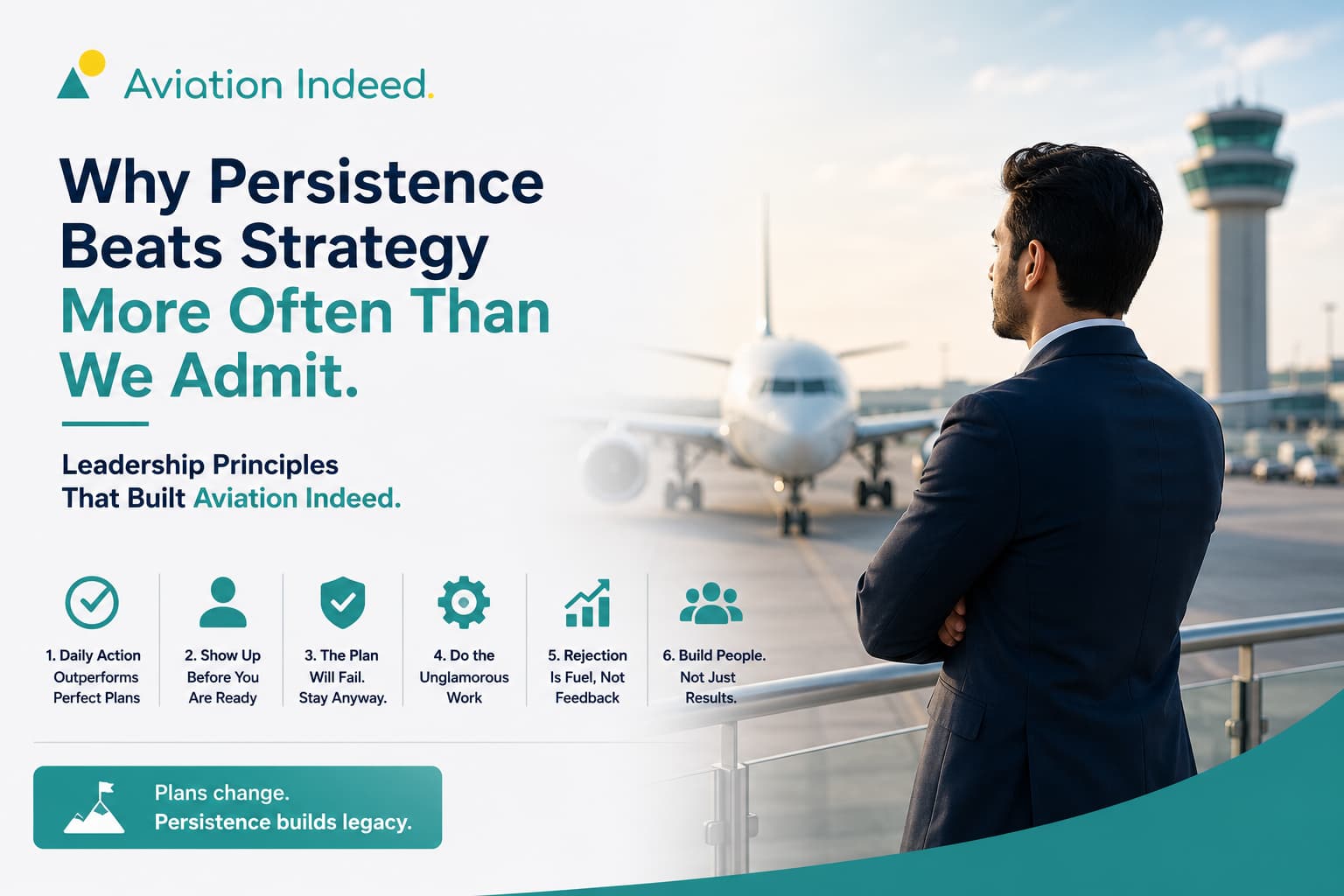
There is a widely held belief in business circles that success belongs to the people who plan the best. The cleanest deck. The smartest market entry. The flawless strategy. The right idea, the right time, the right team.
It is a comforting belief. It is also incomplete.
Across nine years of building Aviation Indeed into one of India's most recognised aviation recruitment partners, with 20,000+ professionals placed across 150+ clients and a network of 400,000+ aviation experts, one pattern has stood out more clearly than any other.
Strategy matters. But persistence is what actually builds businesses, particularly in industries as operationally complex as aviation.
Plans get rewritten. Markets shift. Regulations change. Mandates collapse. The companies that survive these disruptions are rarely the ones with the most elegant plans. They are the ones whose commitment outlives every plan they make.
This guide breaks down six persistence principles that have shaped how Aviation Indeed has grown, and why these same principles matter for any founder, leader, or business operating in aviation or adjacent industries.
1. Daily Action Outperforms Perfect Plans
Most early-stage businesses spend too much time refining their plans and not enough time testing them in the market.
In its earliest days, Aviation Indeed operated with one simple discipline: show up consistently, even at 80% readiness. The pitch was not perfect. The materials were not polished. The processes were still being built. But outreach happened every single day.
Fifty cold emails a day from a prepaid phone, while many competitors waited to perfect their decks. That single discipline compounded into the relationships that became the foundation of the business.
The principle is simple. A 70% effort delivered consistently for twelve months will outperform a 100% effort delivered occasionally. In aviation, where hiring cycles stretch and operational windows are tight, daily action is not just a productivity habit. It is a competitive strategy.
This same discipline now underpins how Aviation Indeed approaches client mandates, candidate engagement, and workforce planning. The depth required is one of the reasons we have written about why aviation recruitment requires industry-specific expertise, where consistency in execution often matters more than the cleverness of the original plan.
2. Show Up Before You Are Ready
The first major placement Aviation Indeed delivered came from a cold call to an airline with which the company had no prior relationship, no introduction, and no track record.
There was no perfect pitch. There were no case studies to share. There was no website worth showing. What existed was a phone, a list of contacts, and the willingness to make the call anyway.
That conversation turned into a partnership that lasted years.
The lesson is not about the call itself. It is about a deeper truth that most opportunities do not wait for readiness. They wait for presence. Polish can be added later. The opportunity to be in the room cannot be recreated after the moment has passed.
For aviation businesses, this principle plays out in client conversations, vendor relationships, and talent partnerships every single week. The teams willing to show up before they feel ready consistently capture relationships that more cautious competitors miss.
3. The Plan Will Fail. Stay Anyway.
In the early years of Aviation Indeed, an entire MRO recruitment drive collapsed two weeks before deployment. Months of sourcing, screening, training, and coordination unravelled almost overnight.
The team rebuilt the pipeline in ten days and delivered on time.
This is not a story about heroism. It is a story about the actual nature of aviation operations. Plans break. Aircraft go AOG. Routes get cancelled. Regulations shift mid-cycle. Candidates drop out at the last hour. Seasonal hiring spikes arrive earlier than forecast.
The organisations that succeed in aviation are not the ones with the most resilient plans. They are the ones whose commitment outlives any individual plan they make. When the plan fails, the team stays. The pipeline gets rebuilt. The delivery continues.
This operational fragility is explored more practically in our analysis of why traditional hiring fails in the aviation industry, where the cost of plan-dependence becomes visible the moment something disrupts the cycle.
4. Do the Unglamorous Work
In its first two years, more than 60% of Aviation Indeed's placements came from direct outreach. Cold calls. Walk-ins. Manual candidate screening. Late evenings spent verifying documents. Weekends spent ensuring a single candidate's joining went smoothly.
None of this work appeared scalable on paper. None of it looked like a growth strategy. All of it compounded.
This is a pattern visible across most durable businesses. The work that competitors avoid because it is slow, repetitive, and quietly exhausting is usually the work that builds the deepest moat. Capital can copy a strategy. It cannot replicate the trust built through hundreds of small, unscalable interactions over years.
For aviation employers and recruitment partners, this is particularly true. Aviation is a sector where reliability is non-negotiable, candidate quality is operationally critical, and reputation compounds over decades. The teams willing to do the unglamorous work consistently outperform those chasing only the visible wins.
5. Rejection Is Fuel, Not Feedback
Three years of ground staff hiring rejections in the early days of Aviation Indeed taught the team patterns no textbook could have explained. Why certain candidates dropped out at the final stage. Why some clients hesitated despite clear capability. Why specific seasonal cycles produced higher attrition than others.
None of these patterns appeared in industry reports. They appeared in the rejections themselves.
Many founders treat rejection as feedback to react to. The more useful framing is to treat rejection as fuel and as data. Each "no" clarifies the next move. Each missed mandate sharpens the next pitch. Each lost candidate exposes a gap in the screening process that no internal review would have caught.
This principle applies far beyond recruitment. Any business operating in a regulated, relationship-driven industry like aviation will face structural rejection that is not personal. The teams that survive are the ones who learn from it without taking it as a verdict.
This long-arc pattern of small adjustments compounding into structural insight is a recurring theme in how the aviation talent landscape is shifting, as examined in our outlook on the aviation hiring landscape in India for 2026.
6. Small Wins Compound Quietly
Long before Aviation Indeed had meaningful revenue, the company offered free training and career guidance to over one million aviation aspirants. There was no immediate return. No conversion funnel. No paid product attached.
What that decision built, slowly and quietly, was trust.
Years later, when paid recruitment platforms entered the market with aggressive marketing budgets, the aviation professionals Aviation Indeed had supported stayed. Many returned as candidates. Some referred their colleagues. Others became hiring managers and brought mandates back to the team that had once helped them at the start of their careers.
This is the quietest principle in this list, and arguably the most important one. Small wins do not look impressive in real time. They look like overhead. They look like effort that should have been redirected to higher-ROI activities. But over years, they compound into the most durable form of competitive advantage that exists in service businesses, which is genuine, earned trust.
For aviation organisations, this principle is especially relevant. The industry is small, deeply networked, and built on long memory. The candidates supported today become the leaders making hiring decisions a decade from now. The clients served well today recommend new mandates without being asked.
The Principle That Holds the Others Together
If the six principles above were reduced to a single underlying idea, it would be this: lower the bar for what counts as forward motion, and refuse to stop moving.
There are quarters in every business, particularly in aviation, where very little visibly works. Mandates fall through. Hiring cycles slow. Cash tightens. Senior team members move on. In those quarters, strategy alone cannot pull a business forward. Only persistence can.
Some weeks, forward motion is a single placement that pays two salaries. Some weeks, it is one good conversation with a client who is not yet ready to hire. Some weeks, it is simply not closing the business.
The discipline is not to wait for the moment that feels like winning. It is to keep moving until the days stack into weeks, the weeks into a quarter, and the quarter into a turn.
Aviation Indeed's current scale, including a network of 400,000+ professionals, active partnerships across 150+ clients, and operations across 50+ countries, was built on this discipline more than on any specific strategic decision. The same is true of most enduring aviation businesses operating today.
Final Thoughts
Strategy is the easier half of building a business. It is intellectually engaging. It is visible. It is the part that gets discussed in meetings, written about in case studies, and credited in success stories.
Persistence is the harder half, and quietly, the more important one. It is the willingness to keep showing up when the plan has stopped helping. It is the discipline to do the unglamorous work, track the unsexy numbers, and move forward in months where progress is barely visible.
In aviation specifically, where operations are unforgiving, regulations are layered, and trust compounds over years, persistence is not a soft skill. It is a structural advantage.
For aviation businesses looking to build durable hiring strategies, scalable workforce models, or long-term talent partnerships, Aviation Indeed provides specialist hiring and talent solutions for aviation employers, drawn from nearly a decade of operational experience across airlines, MROs, airports, and aerospace organisations.
For more aviation industry insights, leadership perspectives, and recruitment strategy guides, explore the full library on the Aviation Indeed Blog.
Live aviation career opportunities across airlines, airports, MROs, and aerospace companies are available on Aviation Indeed Jobs.