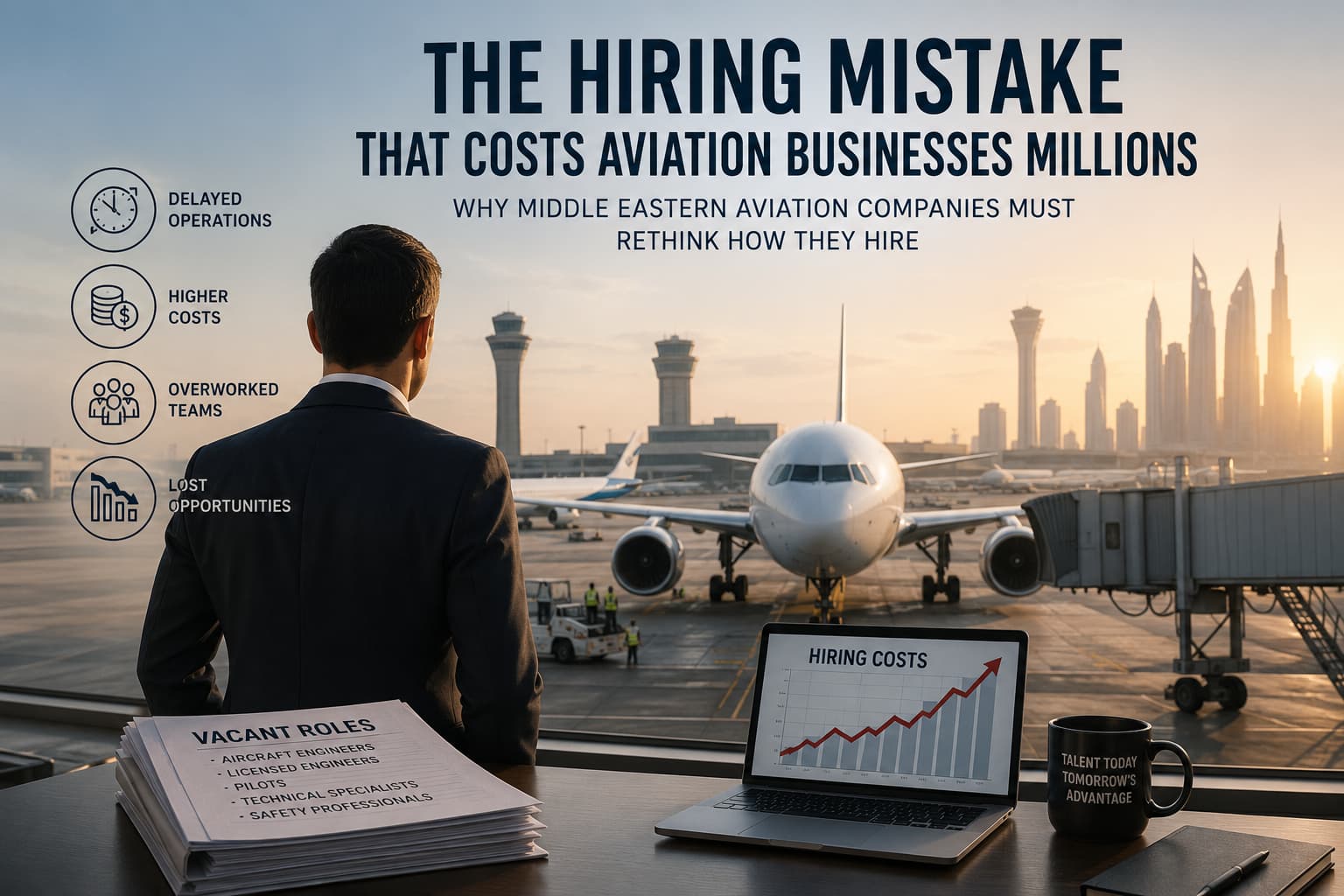

If you've tried to fill a licensed Aircraft Maintenance Engineer role anywhere in the Gulf over the last couple of years, you already know the number nobody likes saying out loud: 60 to 90 days. Sometimes longer. And that's not because there's a shortage of engineers in the world. It's because most hiring processes weren't built for a role this specific.
This isn't a knock on internal HR teams or the recruiters they work with. AME hiring is genuinely unusual as a hiring problem, and once you see why, the fix becomes a lot more obvious — a pattern closely related to why hiring speed has become a competitive advantage across UAE and GCC aviation.
The role that doesn't fit a normal hiring funnel
Most recruitment processes are built around a simple funnel: post the role, collect resumes, filter by keywords, interview the ones who look good on paper. That works reasonably well for a lot of jobs. It falls apart for AME hiring for one simple reason — a resume tells you almost nothing about whether someone can actually do the job.
A license tells you someone is qualified to work on aircraft. It doesn't tell you whether they've worked across multiple fleet types or spent their whole career on one aircraft family. It doesn't tell you how they perform during an AOG situation, when the pressure is real and the clock is running. And it definitely doesn't tell you whether their documentation habits would survive a GCAA audit without a single gap.
None of that shows up in a keyword scan. It shows up in how someone is actually screened, and that takes real technical knowledge on the recruiter's side, not just a job description template.
Why the Gulf specifically feels this more than other regions
Three things are colliding at once across UAE, Saudi Arabia, Qatar, Oman, Bahrain and Kuwait right now.
Fleet growth hasn't slowed down. New aircraft keep arriving across the region's airlines, and every one of them eventually needs a maintenance team behind it, not just pilots and cabin crew.
The licensed AME talent pool hasn't grown at the same pace. Training pipelines for licensed engineers take years, not months, so there's a structural lag between fleet expansion and workforce readiness — one dimension of the wider Gulf aviation talent shortage.
And most hiring in the region is still reactive. A seat opens, then the search starts. By the time a company is actively recruiting, they're already behind, because the strongest candidates were never applying anywhere in the first place — the same reactive-hiring trap we've broken down in the hiring mistake that costs aviation businesses millions.
The hidden cost nobody puts a number on
Everyone talks about cost per hire. Almost nobody talks about the cost of leaving an AME seat empty for three months.
That cost shows up as overtime on the engineers you already have, who are now covering for someone who isn't there yet. It shows up in maintenance schedules that get pushed back because there simply aren't enough hands to keep pace. In some cases, it shows up as aircraft sitting idle longer than they should, which is a very expensive way to wait for a hiring process to finish.
If you've never actually calculated what an open AME seat costs your operation per month, it's worth doing once. Most teams are surprised by the number.
Where the best AMEs actually come from
Here's something that changes how you should think about sourcing entirely: the strongest Aircraft Maintenance Engineers are usually not job hunting. They're already employed, well regarded on their current team, and not browsing job boards on a Tuesday afternoon.
Which means a hiring process built entirely around inbound applications is only ever seeing a specific slice of the market — people between jobs, or people unhappy enough at their current one to be actively looking. That's not necessarily where your best hire is sitting.
The engineers worth hiring usually surface through referral networks, industry relationships, and recruiters who already know the community well enough to reach out directly, rather than waiting for an application to land.
What actually closes the gap
None of this means AME hiring has to stay stuck at 90 days. A few things make the biggest difference, in order of impact.
Screening built for the role, not adapted from a generic template. This means someone evaluating candidates who actually understands licensing, type ratings, and what real technical depth looks like, not someone matching keywords against a job description.
A warm network instead of a cold job posting. Since the strongest candidates usually aren't actively applying anywhere, reaching them requires an existing community and relationships, not another listing on a job board that's competing with a hundred others.
A pipeline that exists before the vacancy does. The companies that stop feeling this squeeze are the ones building relationships with engineers ahead of time, so when a seat opens, there's already a warm shortlist instead of a search starting from zero — the same principle behind building talent pipelines before expansion.
A backup plan for when a strong candidate falls through. It happens — an offer gets countered, a visa process stalls, personal circumstances change. Teams without a second and third option in the pipeline end up restarting the whole process, which is often where the 90-day timeline actually comes from.
How Aviation Indeed Approaches This Differently
This is exactly the gap Aviation Indeed was built to close. Instead of running AME hiring through a generic recruitment funnel, we work from a community of 400,000+ aviation professionals built over the last several years. Most of the engineers we place were never actively job hunting when we first reached out to them.
Every candidate is pre-screened specifically for licensing, technical fit, and deployment readiness before a profile ever reaches an employer, which is what actually shortens the 60 to 90 day timeline that's become normal across the region. We support hiring for licensed AMEs, B1 and B2 engineers, and avionics specialists across UAE, Saudi Arabia, Qatar, Oman, Bahrain, and Kuwait, working with airlines, MROs, and aerospace operators who are tired of the same reactive cycle.
If your team is currently sitting on an open AME requisition, or wants to get ahead of one before it becomes urgent, you can see how we approach it here: Aviation Recruitment for UAE & Gulf.
Frequently Asked Questions
Why do Aircraft Maintenance Engineer roles take so long to fill in the Gulf?
Most hiring processes are built for general recruitment, not the specific technical screening AME roles require. Combined with fleet growth outpacing the region's licensed engineer supply, and most hiring being reactive rather than pipeline-based, open AME roles commonly sit unfilled for 60 to 90 days.
What's the actual cost of an open AME seat, beyond the unfilled salary?
The real cost usually shows up as overtime for the existing engineering team covering the gap, delayed maintenance schedules, and in some cases, reduced aircraft availability. Few companies calculate this cost directly, which is part of why the vacancy often isn't treated with the urgency it deserves.
Are the best AMEs usually applying to job postings?
Generally, no. The strongest, most experienced engineers tend to already be employed and well regarded where they are, meaning they're rarely browsing job boards. Reaching them typically requires direct outreach through an existing professional network, not a public job listing.
What should a screening process for AME candidates actually check beyond the license?
A license confirms baseline qualification. Beyond that, meaningful screening looks at multi-fleet experience, how a candidate has handled AOG or high-pressure situations, and whether their documentation habits would hold up under a GCAA-level audit.
Which countries does Aviation Indeed support for AME hiring?
Aviation Indeed supports licensed AME and aircraft engineer recruitment across UAE, Saudi Arabia, Qatar, Oman, Bahrain, and Kuwait, working with airlines, MROs, and aerospace operators across the region.
How is Aviation Indeed's approach different from a generalist recruitment agency?
Aviation Indeed works exclusively within aviation, drawing from a community of 400,000+ aviation professionals rather than a generic resume database. Screening is built specifically around licensing, technical fit, and deployment readiness, and much of the sourcing happens through direct outreach to engineers who weren't actively job hunting, rather than relying only on inbound applications.