
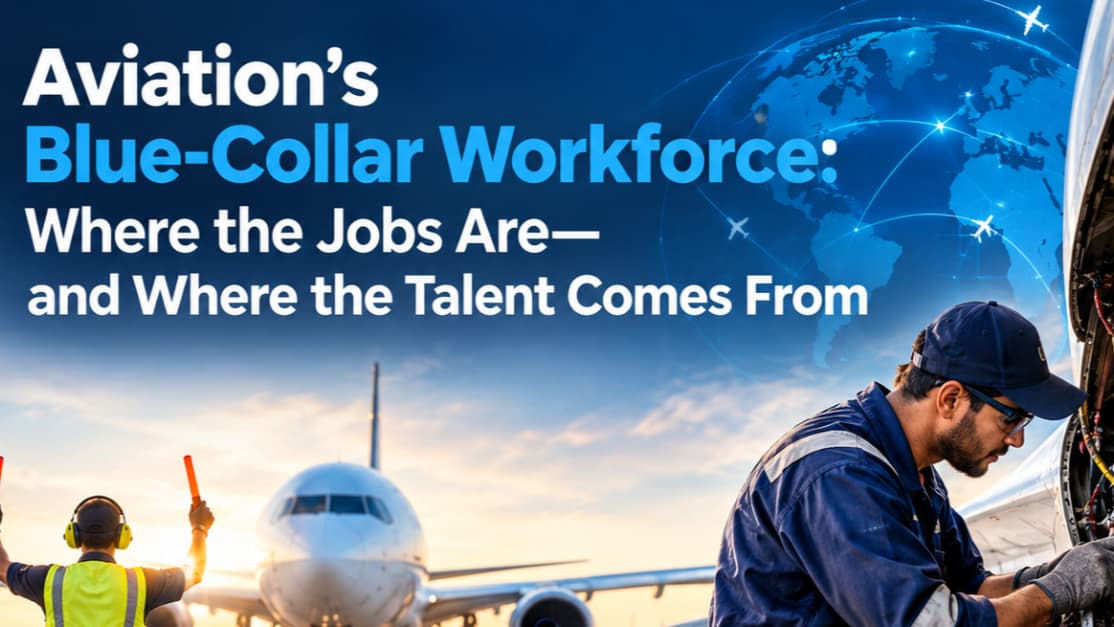
Before passengers board, a team has already begun its work.
A technician checks an aircraft. A ramp agent positions equipment. A cargo handler secures freight. A cleaner prepares the cabin. A refuelling team completes its safety checks. A stores assistant makes sure the right part is ready at the right time.
These jobs may happen outside the cabin and cockpit, but aviation cannot operate without them.
As aircraft fleets, air travel, maintenance and air cargo grow, employers need practical skills across airports, aircraft maintenance, manufacturing, logistics and ground operations. The challenge is that demand and supply rarely line up neatly. A vacancy in one country does not automatically match the skills available in another. Training, licences, language, work permits, shift patterns and local experience can all affect whether a worker is ready to start.
Aviation's blue-collar workforce is not a supporting detail. It is the team that turns a flight plan into a safe departure.
Where Is Aviation Workforce Demand Growing?
There is no single global database that counts every blue-collar aviation vacancy by country. Forecasts also vary by role and methodology. One useful indicator is Boeing's 2025 forecast for cumulative commercial aviation hiring through 2044. It covers pilots, technicians and cabin crew, not the full range of airport, cargo, manufacturing or facilities jobs. The figures show where broad aviation activity is expected to create substantial workforce demand; they are not vacancy counts or blue-collar-only totals.
| Region | New Technicians (2044) | Total New Aviation Professionals | What the Regional Figure Tells Us |
|---|---|---|---|
| Eurasia | 165,000 | 550,000 | Largest total in Boeing's regional forecast |
| North America | 123,000 | 435,000 | High forecast hiring across pilots, technicians and cabin crew |
| China | 131,000 | 426,000 | Significant projected workforce need alongside aviation growth |
| Southeast Asia | 78,000 | 243,000 | Identified by Boeing as one of the fastest-growing regions for personnel demand |
| Middle East | 63,000 | 234,000 | Significant projected hiring across aviation roles |
| South Asia | 45,000 | 141,000 | Identified alongside Southeast Asia as a fastest-growing region for personnel demand |
| Latin America | 42,000 | 134,000 | Regional demand across aviation roles |
| Northeast Asia | 27,000 | 92,000 | Regional hiring need across the three forecast role groups |
| Africa | 24,000 | 74,000 | Regional hiring need across the three forecast role groups |
| Oceania | 12,000 | 41,000 | Smaller total, but still a substantial workforce requirement |
Source: Boeing's 2025 Pilot and Technician Outlook.
Boeing's categories are regions, not individual countries. "New technicians" refers to Boeing's commercial aviation forecast category, not every type of ground, manufacturing or warehouse worker.
Boeing estimates that about two-thirds of its projected personnel demand is for replacement hiring as workers leave the industry, with roughly one-third supporting fleet growth. That matters: the workforce challenge is not only about finding more people. It is also about retaining experienced employees and passing their knowledge on, a dynamic also shaping the global CAT A engineer shortage.
Is There a Country-by-Country Demand-Supply Gap?
Public forecasts offer a clearer picture of regional hiring demand than of the number of qualified workers available to move into each job. Labour supply is difficult to compare across countries because training records, licences, occupational definitions, immigration rules and hiring data differ.
That means it would be misleading to claim a precise global ranking of countries that "supply the most" blue-collar aviation workers without comparable data. A responsible hiring plan distinguishes between:
- Demand locations: countries and regions where employers expect hiring needs
- Potential talent-source markets: places where relevant training, technical experience or workforce-mobility routes may be available
- Job-ready supply: candidates who meet the specific experience, licence, language, work-authorisation and safety requirements for a particular vacancy
The distinction matters. A country may have many aviation students, but that does not tell an employer how many are qualified and available for a specific MRO shift, airport location or aircraft type.
Demand Regions and Potential Sourcing Approaches
The table below combines Boeing's regional demand signals with illustrative sourcing approaches, not a ranked list of exporting countries. Employers should validate talent availability and credentials for each job and destination.
| Region | Demand Signal | Potential Sourcing Approach |
|---|---|---|
| North America | 435,000 new professionals through 2044, including 123,000 technicians | Combine local technical-college and apprenticeship routes with targeted national and international searches for hard-to-fill skills |
| Eurasia | Largest regional total: 550,000 new professionals, including 165,000 technicians | Build country-specific pipelines through local training providers, employer networks and properly assessed cross-border recruitment where shortages remain |
| China | 426,000 new professionals, including 131,000 technicians | Plan around domestic training and hiring systems, and confirm local qualification and employment rules before considering any cross-border pathway |
| Southeast Asia | 243,000 new professionals, including 78,000 technicians; identified as fast-growing | Explore local technical programmes and regional mobility, matching each candidate's credentials to the destination regulator and employer requirements |
| Middle East | 234,000 new professionals, including 63,000 technicians | Use local recruitment and training, supplemented where necessary by transparent international hiring with clear relocation, licensing and contract information |
| South Asia | 141,000 new professionals, including 45,000 technicians; identified as fast-growing | Develop local college, apprenticeship and employer-linked training routes; assess international recruitment against verified experience, credential recognition and worker protections |
| Africa | 74,000 new professionals, including 24,000 technicians | Invest in local technical training and regional partnerships, while identifying whether specialist requirements can be met through cross-border recruitment |
| Latin America | 134,000 new professionals, including 42,000 technicians | Build local pipelines and consider regional mobility where skills and licences are suitable for the specific role |
This is not a claim that any listed country is a top global labour exporter. It is a hiring-planning framework based on forecast demand regions.
The Philippines, India and other countries with aviation training and technical education programmes are often considered by employers building candidate pipelines. But a country's training capacity alone does not establish that it is a top supplier of job-ready workers. Employers need role-specific evidence: graduate numbers, experience, credential status, candidate availability, work authorisation and successful retention.
The right question is not simply "which country has workers?" It is: where can we find people who can safely and fairly move into this role, and what support will help them succeed?
What Jobs Are Included in the Blue-Collar Aviation Workforce?
Aircraft Maintenance and MRO
Example roles: Aircraft mechanic, maintenance technician, avionics technician, engine or structures technician, maintenance assistant.
Typical skills or requirements: Mechanical or electrical aptitude, safety procedures, technical training, and licences or certifications where required.
Airport Ground Operations
Example roles: Ramp agent, ground handling agent, baggage handler, aircraft marshaller, turnaround coordinator.
Typical skills or requirements: Safety awareness, teamwork, communication, equipment operation and shift flexibility.
Cargo and Logistics
Example roles: Cargo agent, warehouse operative, load control assistant, freight handler, stores and materials assistant.
Typical skills or requirements: Inventory handling, documentation, digital systems, dangerous goods awareness where required and attention to detail.
Aircraft Manufacturing
Example roles: Aircraft assembler, composites technician, machinist, sheet-metal worker, production operator, quality inspector.
Typical skills or requirements: Technical drawing, tool use, precision, quality procedures and manufacturing skills.
Cabin and Airport Services
Example roles: Cabin cleaner, cabin appearance technician, catering operative, passenger service assistant.
Typical skills or requirements: Hygiene and safety procedures, customer awareness, teamwork and reliable shift attendance.
Airport Facilities and Equipment
Example roles: Ground support equipment mechanic, facilities technician, vehicle operator, electrical maintenance assistant.
Typical skills or requirements: Equipment maintenance, electrical or mechanical skills, safety checks and relevant permits.
Fuel and Airside Services
Example roles: Aircraft refuelling operator, fuel farm technician, airside driver.
Typical skills or requirements: Safety-critical procedures, accurate documentation, equipment operation and airside permits.
Security and Safety Support
Example roles: Aviation security screener, access control staff, safety assistant.
Typical skills or requirements: Background checks, local regulatory training, observation skills and procedural discipline.
Job titles and requirements differ by employer, country and regulator. A ramp role at one airport may require different permits and equipment experience from a similar role elsewhere. A maintenance position may require a recognised licence, while an entry-level assistant role may provide a route toward further training.
Local Hiring and Cross-Country Recruitment Both Matter
Not every aviation opportunity requires a worker to leave their country, or move to a major city. Airports, MRO facilities, manufacturers, cargo operators and suppliers create jobs in many communities. Local hiring can strengthen those communities and help employers develop a workforce familiar with local procedures.
Employers can build local supply by working with nearby schools, colleges and technical institutes; offering apprenticeships; making entry-level roles visible; and creating progression from general operative jobs into skilled technical positions.
Cross-country recruitment can help when local hiring cannot meet a particular need. It may be relevant for specialist maintenance, production ramp-ups, airport operations or large project-based hiring. But it requires careful planning: work authorisation, licensing, qualification recognition, language, accommodation, safety training and contract terms all need to be clear, the same planning discipline we've outlined for cross-country aviation hiring more broadly.
For candidates, a responsible process explains the job, pay, location, shifts, required documents, any fees and the conditions of employment before they make a decision. For employers, it means verifying credentials and providing practical onboarding after arrival.
The aim is not simply to move workers to vacancies. It is to connect a real job need with a prepared candidate, fair conditions and support that helps the worker succeed.
How Aviation Indeed Can Help Employers Build the Pipeline
Aviation Indeed describes services for aviation employers that include end-to-end recruitment, candidate sourcing and screening, onboarding support, managed HR services, campus hiring, and a Recruit, Train and Deploy model for airport and allied services. It also describes access to an aviation-focused talent pool. These are the company's public descriptions of its offerings, not independent evidence of hiring outcomes. See Aviation Indeed's hiring solutions.
For employers, this type of aviation-focused partner can help organise the practical steps between identifying a workforce need and getting trained workers onto the job. The exact scope should be agreed for each project and checked against local employment and regulatory requirements.
A Step-by-Step Hiring Process
- Map the workforce need. Define roles, headcount, location, shift patterns, start dates and the length of the hiring requirement. Separate urgent vacancies from longer-term pipeline needs.
- Confirm what the job actually requires. Identify essential licences, experience, safety checks and work authorisation. Separate these from skills that can be taught through onboarding.
- Choose local, national or cross-border sourcing. Assess the available candidate pool near the worksite first. If it does not meet the need, consider wider recruitment based on verified role requirements, local rules and candidate support.
- Build the sourcing plan with a specialist partner. Agree target profiles, locations, recruitment channels, candidate communications, screening steps and timelines with Aviation Indeed or another suitable workforce partner.
- Screen for skills and readiness. Check experience, practical capability, credentials, language needs, security requirements and the candidate's understanding of the role. For regulated positions, verify licences with the relevant authority.
- Close skill gaps before deployment. Where appropriate, connect candidates to employer-linked training in airport safety, equipment, procedures, documentation or other job-specific requirements. Confirm who provides and pays for each part of training.
- Make an informed offer. Give candidates clear written information about pay, duties, shift patterns, location, employment terms, relocation support and any required fees or documentation.
- Onboard for safety and performance. Provide site orientation, role-specific training, a named supervisor and supervised practice. Confirm competence before assigning independent safety-critical work.
- Track retention and improve the funnel. Review time to hire, training completion, attendance, safety observations, retention and worker feedback. Use the results to improve the next hiring cycle.
This sequence turns recruitment from a one-time transaction into workforce planning. It helps employers see where candidates come from, what they need to be ready and how to build a reliable pipeline for future demand.
Training Is the Bridge Between Ability and Readiness
Many candidates bring practical skills from manufacturing, automotive, logistics, warehousing, rail, construction or military technical work. They may have experience repairing vehicles, operating machinery, handling inventory or assembling products. They may still need aviation-specific training.
Depending on the job, that could include airside safety and airport driving; human factors and safety reporting; aircraft familiarisation; tool control and maintenance documentation; dangerous goods awareness; security procedures and background-check preparation; quality standards and workplace discipline; digital inventory, maintenance or ground handling systems; and job-related language support.
Training should be linked to actual roles and hiring plans. Employers, colleges, training providers and workforce partners can coordinate course content, practice equipment, assessments and interviews so candidates understand the destination from the beginning.
How Companies, Colleges and Governments Can Improve Supply
Employers can forecast workforce requirements early, especially for projects and seasonal peaks; explain job duties, pay, shifts, location and requirements clearly; recognise transferable skills from other industries; offer apprenticeships, practical placements and entry-level training; invest in supervisors and retention, not only recruitment; and work with recruitment partners responsibly and measure hiring outcomes.
Colleges and training providers can consult employers on course content and current skills needs; offer practical training and work placements; explain licences and certifications in plain language; connect graduates to employers before the end of their courses; and update programmes as equipment, processes and digital tools change.
Governments and regulators can support technical education, apprenticeships and career awareness; set clear rules for safety-critical work and qualification recognition; improve access to training facilities and regional opportunities; protect workers from misleading recruitment practices; and coordinate workforce planning with employers and education providers.
Aviation's workforce supply is not a tap that can simply be turned on. It is a pipeline that must be built, maintained and trusted, locally and across borders.
Frequently Asked Questions About Aviation Blue-Collar Jobs
Which countries have the highest forecast aviation hiring demand?
Boeing's 2025 forecast reports regional, not country-level, totals through 2044. Its largest totals are Eurasia (550,000), North America (435,000) and China (426,000). These numbers cover new pilots, technicians and cabin crew, not all blue-collar aviation jobs or current vacancies.
Which countries supply the most blue-collar aviation workers?
There is no consistent public dataset that ranks countries by the number of blue-collar aviation workers they supply internationally. Employers should assess source markets using relevant training output, verified experience, credentials, candidate availability, work authorisation and job-specific fit.
Can an aviation ground worker get a job in another country?
Potentially, if the worker meets the destination country's employment, security, training and permit requirements. Some technical roles may also require a locally recognised licence. Candidates should receive transparent information about the role and employment terms before accepting an offer.
Does every aviation blue-collar job require a licence?
No. Requirements depend on the job. Some maintenance and safety-critical duties require specific licences or certifications. Other ground operations, cargo, cleaning, manufacturing and support roles may rely on employer training and permits.
How does aviation recruitment help employers close workforce gaps?
A specialist recruitment partner can help define role profiles, source and screen candidates, coordinate hiring and onboarding, and connect recruitment with training where those services are offered. Employers remain responsible for verifying qualifications, following local law and ensuring workers are trained for the work.
The People Behind Every Takeoff
Every departure rests on hundreds of careful actions. A tool is accounted for. A pallet is secured. A vehicle is checked. A panel is inspected. A cabin is prepared. A team communicates clearly under time pressure.
These actions rarely make the passenger announcement. But aviation depends on them.
The opportunity now is to make these careers more visible, connect training to real work and make hiring pathways clearer, within countries and across borders. When employers, educators, governments and workforce partners work together, people with practical skills can find a route into aviation, and aviation can find the people it needs.
The next takeoff begins long before the engines start. It begins with a person who sees a future in the work, and a pathway that helps them reach it.