For most of the last two decades, HR has been quietly underestimated in business conversations. Treated as administrative support. Measured by payroll accuracy and event execution. Asked to attend strategy meetings, but rarely invited to shape them.
That perception is changing, but unevenly.
Across the 150+ aviation, aerospace, and industrial clients Aviation Indeed has supported, one pattern stands out clearly. The organisations that scale efficiently, retain talent, and respond well to disruption are almost always the ones with a serious HR function. The organisations that struggle through every hiring cycle, every regulatory change, and every market shift typically have HR teams stuck in transactional mode.
The difference is not headcount or technology budget. It is capability.
In 2026, the HR teams that genuinely move organisations from one level of performance to the next are building a specific set of skills that most traditional job descriptions still do not capture. These capabilities are not visible on LinkedIn posts or in conference keynotes. They are, however, exactly what serious leadership teams now expect from their HR functions.
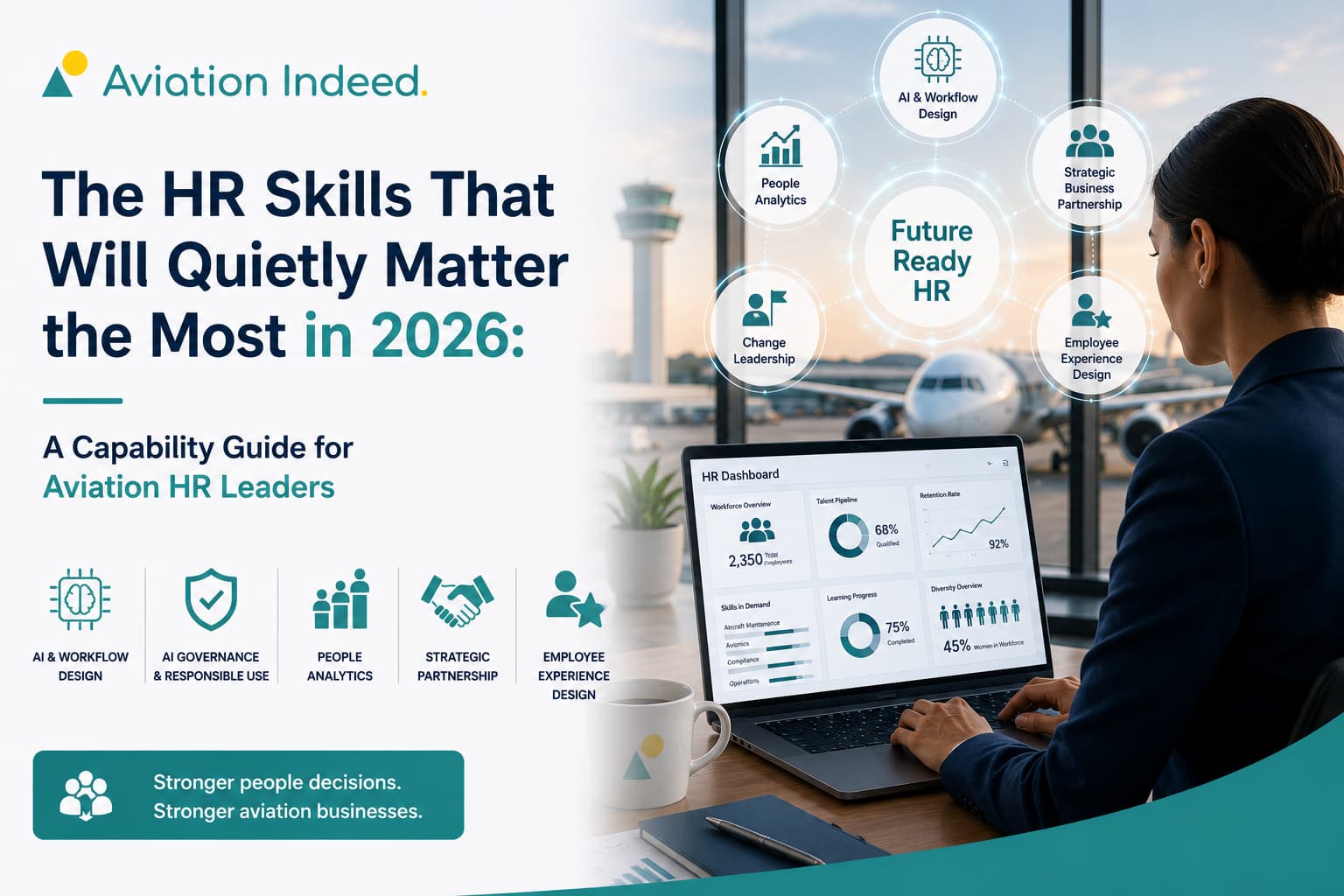
This guide breaks down the five HR capabilities that separate average teams from exceptional ones in 2026, with particular focus on how they apply to aviation, aerospace, MRO, and ground operations environments where workforce decisions carry direct operational consequences.
Why HR Capability Matters More in 2026 Than Ever Before
Three structural shifts are reshaping what HR is expected to deliver.
First, the speed of workforce change has accelerated. Skills become outdated faster, hiring windows are shorter, and the cost of a wrong hire has climbed significantly. The Society for Human Resource Management identified leadership and management development as the top HR priority in 2025, alongside rising concerns about employee burnout. HR teams are no longer being asked to support workforce change. They are being asked to lead it.
Second, AI has moved from periphery to core. Recruitment platforms, learning systems, performance management tools, and workforce planning engines are increasingly AI-enabled. HR teams that cannot govern, evaluate, and shape these systems will quickly find themselves managed by them, rather than the other way around.
Third, the workforce itself has changed. Multi-generational teams, hybrid work models, increasingly mobile aviation professionals, and a sharper focus on capability over credentials have made traditional HR playbooks visibly outdated. The frameworks that worked in 2018 do not scale into 2026.
Against this backdrop, five HR capabilities have emerged as the clearest markers of high-performance HR functions. They are not the only capabilities that matter. They are the ones that consistently differentiate teams that drive results from teams that merely keep operations running.
Many of these themes overlap with the structural hiring challenges examined in our analysis of why traditional hiring fails in the aviation industry, where the cost of underdeveloped HR capability becomes visible the moment volume, speed, or complexity increases.
1. Human and AI Workflow Design
The real advantage of AI in HR is no longer access to the technology. Most HR teams now have access to AI-enabled tools, whether through their ATS, their HRIS, their assessment platforms, or their learning systems.
The real advantage is workflow design. Specifically, the ability to redesign HR processes so that AI improves decision quality and reduces friction, rather than simply accelerating existing inefficiencies.
Workforce management platforms have evolved from systems of record to what industry analysts now describe as systems of intelligence. This shift, driven by integration of AI into demand forecasting, schedule optimisation, and task assignment, has created an opportunity that most HR teams are still underusing. Faster output is not the goal. Better outcomes are.
For aviation HR teams specifically, this matters in three high-leverage areas.
Recruitment workflows, where AI can pre-screen for licence validity, type-rating fit, and geographic mobility, freeing recruiters to focus on judgement-heavy assessment stages. Workforce planning workflows, where AI can forecast attrition risk, fleet expansion-driven demand, and seasonal load before they create operational pressure. Learning and development workflows, where AI can map skill gaps to training pathways and prioritise interventions based on operational criticality.
The HR teams getting this right in 2026 are not the ones with the most AI tools. They are the ones who have rebuilt their workflows around AI, rather than simply layering AI on top of legacy processes. This is the same operational discipline that strong aviation hiring partnerships rely on, as explored in our piece on why aviation recruitment requires industry-specific expertise.
2. AI Governance and Responsible Use
The flip side of AI workflow design is AI governance. As HR functions increasingly use AI for hiring decisions, performance reviews, and workforce analytics, they are also becoming responsible for the risks those systems introduce.
Industry bodies including SHRM have called publicly for HR functions to lead on the human impact of AI, including communication, reskilling, and responsible deployment. In practice, this means HR teams now need to define clear guardrails across four areas.
Data privacy. Candidate and employee data flowing through AI systems must remain compliant with relevant data protection regulations, including GDPR in Europe, India's DPDP Act, and emerging AI-specific frameworks across the GCC and Asia-Pacific.
Bias monitoring. AI systems trained on historical hiring data can quietly amplify existing biases. Strong HR teams in 2026 are building structured bias audits into their AI-enabled workflows, particularly for screening, shortlisting, and promotion decisions.
Decision auditability. Any AI-influenced HR decision must be explainable. If a candidate is rejected, a promotion is declined, or a performance rating is generated, the HR team should be able to articulate the reasoning behind the output.
Human judgement preservation. Perhaps the most important governance principle. AI should sharpen human judgement, not replace it. The HR teams that lose this discipline quickly find their decisions becoming faster, but not better.
In aviation specifically, where hiring decisions can affect safety-critical operations, the governance bar is naturally higher. A wrong cabin crew hire is an operational issue. A wrong engineer or safety officer hire can be a regulatory issue. HR teams operating in these contexts cannot afford ungoverned AI use.
3. Skills Architecture Over Resume Screening
Traditional hiring has long relied on credentials. Degrees, certifications, prior employers, and job titles have served as proxies for capability.
That model is breaking down for two reasons. First, the gap between what a credential signals and what a candidate can actually do has widened significantly, particularly in fast-evolving technical fields. Second, the talent market itself has globalised, with candidates from non-traditional backgrounds increasingly outperforming those from conventional pipelines.
Leading HR functions in 2026 are responding by building what is now widely referred to as a skills architecture. The underlying logic mirrors the AIHR T-shaped HR professional competency model, which combines broad foundational competencies such as business acumen, data literacy, digital agility, and people advocacy with deep expertise in specific domains such as talent acquisition, learning and development, people analytics, and organisational development. Platforms such as Oracle Dynamic Skills, which uses AI to catalog skills, recommend roles, and surface gaps, are increasingly being adopted to operationalise this shift.
For aviation HR teams, a strong skills architecture typically includes four layers.
A defined skills taxonomy covering both technical skills (such as type ratings, licence categories, simulator experience, and platform-specific expertise) and behavioural skills (such as procedural discipline, communication under pressure, and shift adaptability).
Practical assessment methods that test demonstrable capability, rather than rely solely on documented credentials. For aviation this often includes scenario-based interviews, technical aptitude testing, and structured operational readiness reviews.
Internal mobility logic that maps current employees to emerging roles based on skills, not just historical job titles. In an industry where fleet expansions, route launches, and new technology rollouts constantly create new roles, this is critical.
Learning pathways tied directly to identified skill gaps, so that capability development is treated as a measurable workforce outcome rather than a training calendar exercise.
This shift is particularly relevant given how rapidly aviation hiring requirements have changed. The implications are examined in detail in our outlook on the aviation hiring landscape in India for 2026, where the gap between credentialed candidates and operationally ready candidates is widening visibly.
4. Recruiting Risk Management
Recruitment has quietly become one of the highest-risk functions inside modern organisations. Three developments have driven this shift.
Resume fraud has risen sharply. Misrepresented credentials, fabricated experience, undisclosed gaps, and outright identity manipulation are now significant enough that most large enterprises have introduced layered verification protocols. AI-generated applications have added a new dimension. Tailored resumes, AI-written cover letters, and AI-assisted interview responses have made the early stages of hiring noisier and harder to evaluate. Data-handling risk has increased. Candidate data flowing through ATS systems, third-party assessment platforms, and AI tools is now subject to far more regulatory scrutiny than it was even three years ago.
In response, high-performance HR teams in 2026 are treating recruitment as a structured risk management function, not just a sourcing pipeline.
Effective practices typically include layered screening across application, assessment, and verification stages, rather than relying on a single gate. Structured documentation checks for credentials, employment history, and regulatory clearances, particularly for safety-critical or licence-dependent roles. Verified live interaction stages such as video-based assessments or in-person walk-ins to confirm candidate identity and capability. Controlled data handling protocols that limit how candidate data moves between internal systems and third-party tools.
For aviation organisations, this matters even more sharply. The cost of a fraudulent or under-qualified hire in aviation is not measured in onboarding time. It is measured in regulatory exposure, operational disruption, and potential safety implications. The transparency principles outlined in our guide on the airport ground staff hiring process in India reflect this same underlying discipline of structured, documented, and verifiable recruitment.
5. Development That Builds Real Capability
Training has historically been measured by attendance. Courses delivered. Hours logged. Modules completed. Certificates issued.
That measurement framework is becoming visibly insufficient. In 2026, leadership teams are increasingly asking a sharper question. Not how much training was delivered, but how much capability was actually built.
High-impact HR functions are responding by redesigning learning around outcomes, not activity. This shift typically includes four elements.
Capability outcomes defined in advance, with clear measurement criteria for what successful learning looks like in operational terms. Learning pathways tied to specific roles, business goals, or capability gaps, rather than open enrollment calendars. Practical application built into the design, including on-the-job assignments, simulation-based training, and structured stretch projects. Measurement that goes beyond satisfaction scores to include behavioural change, operational performance improvement, and time-to-competency metrics.
For aviation organisations, this capability shift is particularly relevant. Roles such as licensed engineers, safety officers, cabin crew, and ground operations leaders cannot be developed through generic training models. They require structured, scenario-rich, operationally grounded development pathways. The HR teams that build these well typically reduce time-to-deployment significantly, improve early-career retention, and produce stronger performance under operational pressure.
This is also why workforce readiness has become such a sharp differentiator across aviation employers. Many of the longer-term implications are examined in our analysis of the aviation time-to-hire crisis in 2026, where the link between capability development and operational continuity is becoming impossible to ignore.
What These Five Capabilities Look Like When Combined
Individually, each of the five capabilities described above represents a meaningful upgrade to a traditional HR function. Combined, they represent something more significant. They define what a modern, high-performance HR function actually looks like in 2026.
In practice, an HR function operating with all five capabilities tends to show three observable patterns.
Decisions are faster and better. Workflow design plus AI governance means hiring, promotions, and workforce planning decisions are made with less friction and more accuracy.
Talent quality is structurally higher. Skills architecture plus recruiting risk management ensures that the people entering the organisation are genuinely capable, verifiable, and aligned to operational needs.
Capability compounds over time. Outcome-driven development means employees become more valuable over their tenure, rather than plateauing in their first 18 months.
The cumulative effect is significant. Organisations with high-capability HR functions consistently scale faster, retain better, respond to disruption more effectively, and rely less on external firefighting when the operating environment shifts. This is particularly visible in aviation, where workforce volatility has direct operational consequences.
The Capabilities That Will Define Leading HR Teams in 2026
The five capabilities covered in this guide are not novel concepts. Most senior HR leaders have encountered each of them in some form. What has changed in 2026 is the seriousness with which they are being expected, the speed at which they are being deployed, and the visibility they now carry inside leadership conversations.
HR teams that continue to be measured primarily by transactional outputs (payroll accuracy, event execution, policy administration) will increasingly find themselves disconnected from how leadership teams now evaluate workforce performance. HR teams that build the five capabilities above will find themselves at the centre of how organisations actually compete in the next phase of growth.
For aviation organisations specifically, the stakes are sharper. Workforce decisions in aviation carry regulatory, operational, and safety consequences that other industries do not face at the same intensity. The HR functions that recognise this and build accordingly are also the ones that consistently produce the most resilient workforce outcomes.
Final Thoughts
HR is no longer a back-office function in 2026. It is a strategic capability layer that increasingly determines whether an organisation scales smoothly or stalls under operational pressure.
The five capabilities described in this guide, namely human and AI workflow design, AI governance, skills architecture, recruiting risk management, and capability-led development, are not aspirational ideas. They are the practical, measurable, and increasingly non-negotiable markers of a high-performance HR function.
For aviation employers building or restructuring their workforce strategies, the practical question is rarely whether these capabilities matter. The question is how quickly the HR function can develop them in a way that fits the operational realities of airlines, MROs, airports, and aerospace organisations.
Aviation Indeed works with airlines, MROs, ground handling companies, and aviation service providers across more than 50 countries to strengthen workforce planning, recruitment, and talent strategy. To explore how aviation-specific hiring and HR support can complement your internal capability development, visit our hiring and talent solutions for aviation businesses.
For more aviation industry insights, HR perspectives, and workforce strategy guides, explore the full library on the Aviation Indeed Blog.
Live aviation hiring opportunities across HR, recruitment, operations, and management roles are available on Aviation Indeed Jobs.